Last updated November 18, 2026

Free written scope consultation - allowances, timeline, and change-order rules on paper before a single trade is scheduled
The Complete Driveway & Pavers Guide for Lake Forest Homeowners
Most homeowners in Lake Forest choose a driveway paver the way they choose paint: by looking at a color chip. That order is backwards. Here, the subgrade, the sun exposure, and the community you live in narrow the list of workable materials before color ever enters the conversation. The soil under parts of the Saddleback Valley corridor is expansive clay that swells and shrinks with moisture, and a slab poured on a shallow base will crack and shift within a few years no matter how good it looks on day one. This guide walks through material selection, base prep, pattern, drainage, HOA rules, and the full installation sequence, with Lake Forest’s actual conditions as the filter.
Quick Answer
A driveway that lasts in Lake Forest needs a compacted aggregate base of at least 6 inches (more on expansive clay), a paver choice matched to vehicle loads and Southern California UV, drainage designed for Santa Ana wind and winter rain, and a pattern that locks pavers together under tire traffic. Concrete pavers and permeable pavers are the most dependable all-around choices; travertine is beautiful but needs careful base and sealer decisions; clay brick adds character with more maintenance. Get the base and drainage right and the surface will hold. Skip them and no material survives.
Styles & brands we work with
- Kitchen remodeling
- Bathroom remodeling
- Home additions & ADU
- Roofing
- Windows & doors
- Driveway & pavers
- Fence
Table of Contents
- How Lake Forest Soil Changes the Rules for Driveway Pavers
- Concrete Pavers vs. Travertine vs. Permeable Pavers vs. Brick
- HOA Color and Material Rules in Foothill Ranch, Baker Ranch, and Beyond
- Herringbone, Running Bond, and Basketweave: Why Pattern Is Structural
- The Full Installation Sequence, Phase by Phase
- What Drives the Cost of a Paver Driveway in Lake Forest
- Sealing, Cleaning, and Repairs After Installation
- Common Mistakes to Avoid
How Lake Forest Soil Changes the Rules for Driveway Pavers
Expansive clay is the single biggest variable in any hardscape project here, and it’s the one most homeowners never hear about until something goes wrong. Clay holds water and expands, then dries and contracts. A concrete slab resists that movement until it can’t, and then it cracks. Pavers are different: individual units flex with minor movement while the joints absorb stress. But that flexibility only works if the base underneath is engineered to distribute load and keep water moving away from the clay.
In sandier coastal cities, a base of 4 inches of compacted aggregate can sometimes work for pedestrian areas. Here, 6 inches of compacted base is the floor for a driveway, not the target. On lots with heavier clay or a history of movement, we specify deeper base sections, often with a geotextile separation fabric between the subgrade and the aggregate to keep fine clay particles from migrating up into the base over time. That fabric is invisible in the finished product and it’s one of the first things a corner-cutting contractor skips.
Base compaction is measured in passes, not minutes. Each 2-inch lift of aggregate should be vibratory-compacted before the next goes down. Stacking 6 inches and rolling it once leaves voids, and voids are where settling begins. If you see a contractor dumping all the base at once, ask how they intend to compact it in lifts. On a typical Lake Forest driveway, proper base prep is a meaningful share of the total job, and it’s the reason paver driveways here outperform poured concrete over the long run.
Drainage ties directly to the clay issue. Water that ponds at the edge of a driveway or against the garage slab will find the clay, and the clay will move. Any driveway design in Lake Forest needs a clear path for water to leave the site, whether that’s a slope to the street, a channel drain, or a permeable surface system. We plan drainage before we plan pattern, because one depends on the other.
Concrete Pavers vs. Travertine vs. Permeable Pavers vs. Brick
Four material families cover nearly every residential driveway in Lake Forest, and each behaves differently under our UV load, vehicle weights, and winter rain. Here’s how they compare on the factors that actually matter.
Concrete Pavers
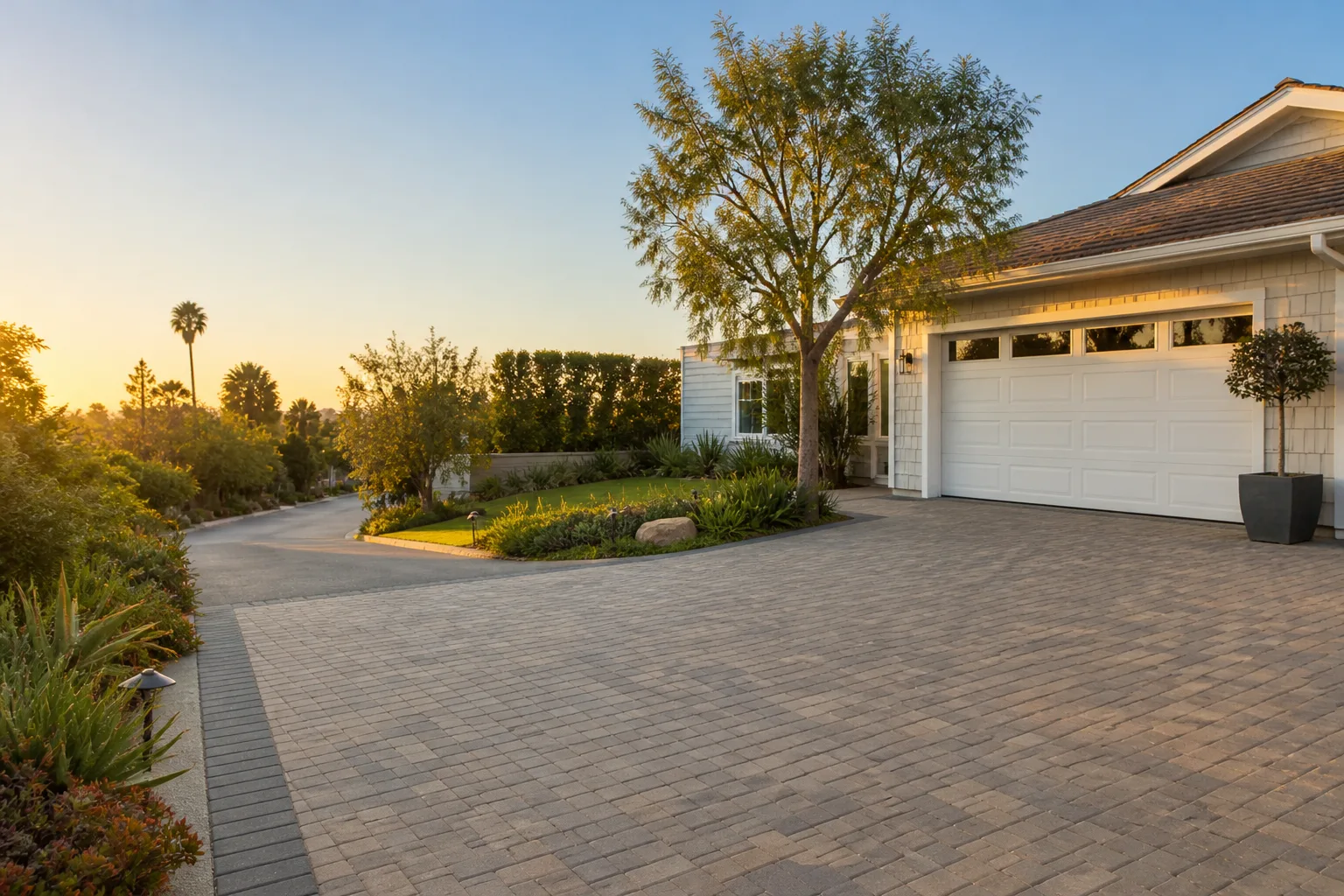
Interlocking concrete pavers are the workhorse choice for Lake Forest driveways. They handle vehicle loads well, resist UV fading through pigmented color, and are easy to spot-repair because individual units can be lifted and reset. Manufacturer programs from Belgard, Unilock, Techo-Bloc, Tremron, and Cambridge Pavers give you real design range: textured finishes, large-format slabs, and color blends that read as stone rather than concrete. Joint sand between pavers absorbs minor movement, which is exactly what expansive clay demands.
Travertine
Travertine is a natural stone, usually set as pavers or in a French pattern, and it delivers a high-end look that concrete can’t quite match. In Southern California sun, however, unsealed travertine absorbs heat and its surface can become porous and stained if not maintained. It also requires a more rigid base and careful edge restraint than concrete pavers, because stone units are heavier and less forgiving. Travertine works beautifully on Lake Forest properties when the installer treats it as a premium installation, not a stone-look shortcut.
Permeable Pavers
Permeable systems allow water to pass through joints or through the units themselves into a base designed to store and infiltrate it. For Lake Forest lots with drainage constraints or generous clay, permeable pavers are a smart engineering answer, because they keep water out of the subgrade rather than directing it across it. They cost more than standard concrete pavers because the base and drainage design are more involved, and they need periodic vacuum sweeping to keep joints open. Where stormwater management matters, they earn that premium.
Clay Brick
Brick pavers bring warmth and character, and the material itself is durable. The challenge in our climate is maintenance: brick is more porous than concrete pavers, so sealing becomes a regular part of ownership, and efflorescence (white mineral bloom) is common on new installations. Brick is also heavier and slower to install, which shows up in labor. If you love the look, brick rewards you, but budget for the upkeep.
HOA Color and Material Rules in Foothill Ranch, Baker Ranch, and Beyond
Lake Forest has a lot of planned communities, and Foothill Ranch and Baker Ranch are two of the most common places where homeowners run into architectural review. If you order a pallet of pavers before your HOA approves a color, you may end up with a very expensive pile of the wrong material.
Most architectural review committees in Lake Forest communities focus on three things: color palette, material type, and how the finished hardscape reads from the street. Earth tones, muted grays, and warm tans tend to pass without much friction. Bright or highly saturated colors, glossy finishes, and materials that look out of character with neighboring homes draw more questions. The committee is protecting curb appeal, and a paver driveway is one of the most visible changes you can make to a lot.
Our advice is to submit the actual product and color sample together with the manufacturer’s spec sheet, and to have your contractor describe the pattern and border in the application. A clear submission moves faster than a vague one. If you’re planning multiple exterior upgrades, such as a matching fence installation along the driveway edge, submit them together so the committee reviews the whole look instead of piece by piece. We’ve found that HOAs respond well to requests that are clearly thought through and consistent.
Not every Lake Forest neighborhood has an HOA, and some have architectural guidelines but no active review process. Ask before assuming. A five-minute call to your community association before you pick a color saves weeks later.
Herringbone, Running Bond, and Basketweave: Why Pattern Is Structural
Pattern is usually discussed as a design choice, and it is one. But on a driveway, pattern also determines how the pavers lock together under tire loads and how the system handles the small movements that clay soil produces. Two patterns doing the same visual job can perform very differently under a car.
Herringbone
The 45-degree and 90-degree herringbone patterns interlock pavers at right angles, which makes the surface extremely resistant to lateral creep and point loads. This is why herringbone is the standard for driveways and why you see it on municipal hardscape and commercial entrances. If you park heavy vehicles, tow a trailer, or have clay with any history of movement, herringbone is the structural answer. It’s roughly our default choice for Lake Forest driveways unless a client prefers something else.
Running Bond
Running bond, where pavers are offset like brickwork, is the most economical pattern and it looks clean and classic. Under vehicle traffic it doesn’t interlock as strongly as herringbone, so edge restraint and base compaction become even more important. It works well for walkways, patio areas, and driveways where the subgrade is well prepared and traffic is light.
Basketweave
Basketweave groups pavers in squares of alternating orientation, giving a strong graphic look and good interlock in both directions. It’s often used as a border or accent band, but it can carry a full driveway when the design calls for it. Like herringbone, it distributes load well; unlike herringbone, it uses more units per square foot, which raises material and labor cost.
Pattern decisions should be made alongside your border design and your driveway’s relationship to the street, not after the pavers arrive. If a design-build team is handling your whole exterior, coordinating the driveway, the fence line, and the roofline in one plan keeps the property visually coherent from the sidewalk to the ridge.
The Full Installation Sequence, Phase by Phase
A paver driveway is a layered system, and every phase of installation matters. This is the sequence a proper installation follows, with a note on what a shortcut looks like at each step.
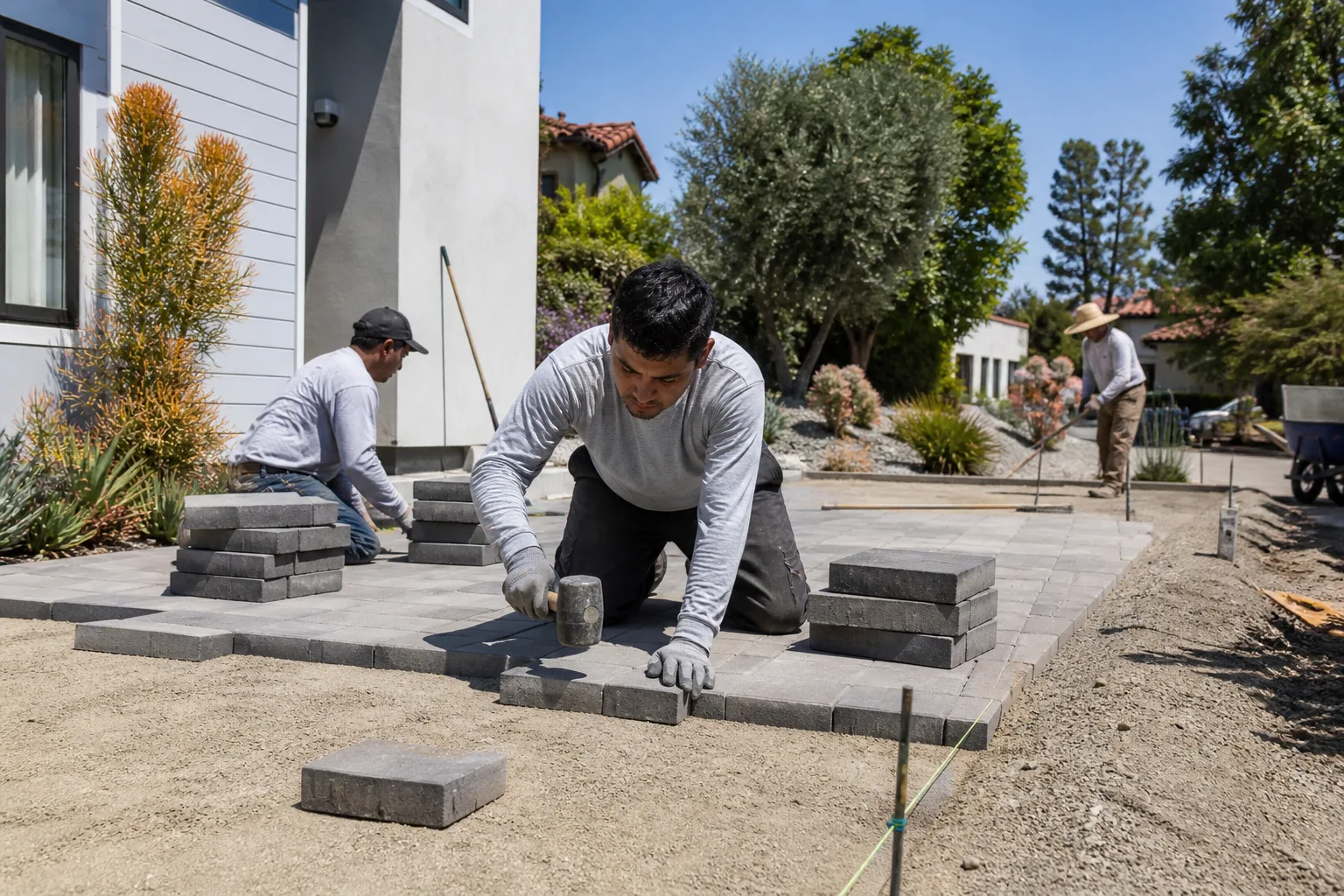
- Layout, demo, and excavation. Mark the driveway edges, remove the existing surface, and excavate to the depth required for base, bedding sand, and pavers. Shortcut: excavating only to the paver thickness and thin base, which forces the base to be too shallow.
- Subgrade preparation and grading. Compact the exposed subgrade and set a slope that sheds water away from the garage and home. Shortcut: skipping subgrade compaction and grading so water drains toward the house.
- Geotextile and base installation. On clay-heavy lots, lay separation fabric, then install aggregate in 2-inch lifts with vibratory compaction between each lift, reaching a finished compacted depth of at least 6 inches (deeper on poor soil). Shortcut: one thick lift, light compaction, or fabric omitted entirely.
- Edge restraint. Install a rigid edge restraint on the driveway perimeter, anchored into the base, so pavers can’t spread under load. Shortcut: relying on sand or soil alone to hold the edge, which fails under vehicle traffic.
- Bedding sand and screeding. Spread a consistent 1-inch sand bedding layer and screed it to final grade. Shortcut: uneven sand depth, which telegraphs through the pavers and causes rocking.
- Paver installation and cutting. Lay pavers in the approved pattern, cut border and edge pieces, and set the field with tight joints. Shortcut: loose joints, sloppy cuts against the garage apron, and no pattern consistency.
- Joint sand and compaction. Sweep polymeric or stabilized joint sand into the joints and plate-compact the surface to seat the pavers and lock the system. Shortcut: skipping final compaction or using loose sand that washes out with the first rain.
- Sealing and clean-up. Once the driveway is fully set, apply sealer if specified, clean the edges, and walk the job with the homeowner. Shortcut: sealing before the system has stabilized, which traps moisture and causes haze.
Each of these phases is a place where a lower bid becomes visible. The sequence is the same on a modest walkway and on a full driveway; only the volume changes. We bring the whole system together under one contractor relationship so base prep, drainage, edge restraint, and finishing aren’t split among separate crews. Our technicians have up to 8 years of experience, and every plan is written out in a line-item estimate before installation begins.
What Drives the Cost of a Paver Driveway in Lake Forest
Cost on a paver driveway is a function of square footage, material, base depth, drainage design, pattern complexity, and how much repair the existing surface needs. There’s no single number, and any contractor who quotes one before seeing your site is guessing. But it helps to know which levers move the price.
- Square footage: the largest single variable, and the easiest to plan around.
- Material: concrete pavers are the middle path; travertine and brick carry a higher material and installation cost.
- Base depth: deeper base on clay-heavy lots adds material and labor, but it’s what keeps the driveway flat.
- Drainage: channel drains, grading, and permeable systems add engineering but solve water problems that would otherwise undermine the driveway.
- Pattern and border: herringbone and decorative borders take more cutting and more units per square foot.
- Existing surface removal: demolishing and hauling old concrete adds a demolition phase.
The right way to price a driveway is with a written line-item estimate that separates demolition, base prep, drainage, pavers, edge restraint, and sealing, so you can see exactly what you’re buying. Our estimates are free, and the written estimate sets the final price with no change orders on a fixed scope. We’ll walk the site with you and explain each line before you decide.
Sealing, Cleaning, and Repairs After Installation
A paver driveway is a low-maintenance surface, not a no-maintenance one. In Lake Forest’s climate, a few habits keep the driveway looking new.
- Sweep regularly. Santa Ana winds bring grit and debris; regular sweeping keeps that grit out of the joints.
- Replenish joint sand as needed. If joints look shallow after a season of rain and wind, top up with the same stabilized sand your installer used.
- Seal on a sensible schedule. Sealer protects color and reduces staining, but it should be applied to a clean, dry, fully set surface. Ask your installer to state a sealing schedule in the estimate.
- Clean stains promptly. Oil from vehicles, grills, or gardening equipment sets faster in hot sun, so address spots early with a mild cleaner.
- Spot-repair single pavers. One damaged unit can be lifted and replaced without touching the rest of the field, which is a real advantage concrete pavers have over a poured slab.
If you notice settling along an edge, rocking pavers, or a low spot that holds water, address it early. Movement usually points to an edge restraint issue or a drainage problem, and both are far cheaper to fix before they spread. A quick inspection after the first heavy winter rain is a good habit.
Common Mistakes to Avoid
- Skipping base depth on clay. Installing a shallow base on Lake Forest’s expansive clay is the number-one reason driveways settle. Six inches of compacted base is the floor, and poorer soil needs more.
- Choosing material before checking HOA rules. Ordering pavers in a color or material your Foothill Ranch or Baker Ranch association hasn’t approved can cost you a reorder. Get approval first.
- Ignoring drainage. If water has nowhere to go, it will find the clay and undermine the base. Plan the slope and drainage before the pavers arrive.
- Picking pattern for looks only. Running bond on a heavy-vehicle driveway without sufficient edge restraint is a structural weak point. Match pattern to load.
- Foregoing edge restraint. Without a rigid edge, pavers spread under vehicle traffic. This is a low-cost detail that determines the driveway’s life.
- Using loose joint sand. Standard loose sand washes out with rain; stabilized or polymeric sand holds the joints and reduces weed growth.
- Choosing the lowest bid without seeing the phases. A bid that doesn’t break out base prep, drainage, and edge restraint is hiding where the corners get cut.
See the difference
 Before
 After
 Before
 After
 Before
 After
When to Call a Professional
Some hardscape repairs are DIY-friendly. A paver driveway in Lake Forest generally isn’t one of them, because the work happens at the base, and the base is under everything else. Call a professional if you’re seeing settlement, rocking pavers, a low spot that pools water after rain, cracking at the garage apron, or an edge that’s spreading into the landscaping. Those symptoms usually trace back to base or drainage issues that can’t be diagnosed from the surface.
Call us if you’re planning a new driveway, replacing cracked concrete, or coordinating a driveway with a fence and other exterior work. Construction Lake Forest offers free estimates in Lake Forest, with written line-item pricing, fixed scope on a defined job, and permits handled where they’re required. Call (888) 397-8184. We answer 24/7. Fast dispatch from 7am to 7pm, Sunday through Friday.
Frequently Asked Questions
At least 6 inches of compacted aggregate base for a driveway, installed in 2-inch lifts with compaction between each lift. On lots with heavier expansive clay, we often go deeper and add a geotextile separation fabric. Anything shallower than 6 inches risks settling, especially where clay is present. Call (888) 397-8184 for a site-specific recommendation.
Concrete pavers are the more dependable choice for a driveway because they handle vehicle loads well, resist UV fading, and are easy to spot-repair. Travertine looks stunning but needs a more rigid base, careful sealing, and a maintenance commitment in Southern California sun. If you love travertine, it can be a great choice on the right base with the right installation plan.
Replacing an existing driveway typically doesn’t require a building permit, but new hardscape that changes drainage, grading, or the footprint of the property may. Permits can vary by lot and by community, so the right answer is to check with the city before work begins. We handle permit coordination on projects where a permit is required, and it’s included in the written estimate.
An individual paver can chip or break, but the driveway as a whole won’t crack the way a poured slab does. Pavers are separate units with joints that flex with minor soil movement, and a damaged paver can be lifted and replaced individually. On expansive clay, that flexibility is why paver driveways tend to outlast concrete.
A typical residential driveway takes several days, and the schedule depends on square footage, base depth, drainage, and how much demolition is involved. Base compaction in lifts is time-consuming, and it’s not a phase to rush. Your written estimate will spell out the phases and the expected schedule.
Yes. Pairing a driveway with a coordinated fence installation gives the property a finished look from the street to the back line, and having both scoped in one plan avoids the scheduling friction of separate contractors. We also connect driveway work to a broader exterior plan when the homeowner is replacing a roof or windows at the same time.
The Bottom Line
A paver driveway in Lake Forest is an engineering decision first and a design decision second. Get the base depth right for our clay-heavy subgrade, plan drainage from the start, choose a material the climate can hold, respect your HOA’s color and material rules, and pick a pattern that interlocks under vehicle load. The surface you see is the smallest part of the system. Whether you’re replacing a cracked slab or planning a full exterior upgrade from the driveway to the roofline, our team at Construction Lake Forest can put the whole scope in one written plan. Explore our driveway & pavers work, and if your project includes added square footage, our home additions & ADU team can pick up where the hardscape ends.
Call (888) 397-8184 to schedule your free estimate. We answer 24/7. Fast dispatch from 7am to 7pm, Sunday through Friday.
Written by the team at Construction Lake Forest.